Showing posts with label Fruit Trees 101. Show all posts

Thursday, December 9, 2010

The Best Tree Care Videos on the web

Chuck Ingels is a master teacher on schoolyard-scale orchards and a dear friend of Common Vision. In this 2-hour segment he goes through the basics of fruit tree care. Below the videos we have outlines that break down the subjects so you can skip to the sections you need. Some of this is more complex then you need to know. Please email or call us with any questions.


Basics of how trees grow:

0:40 Roots - how they grow
4:30 Chilling Requirement
6:40 Sunlight Requirement
7:00 Pollenization
10:15 Soil Requirements
12:20 Parts of the Tree -
17:50 Planting the Tree
26:00 Post-Planting Care
29:30 Water and Irrigation
34:05 Fertilization
36:00 Pruning

Note: on Pruning: Common Vision recommends an open center kept very short. This is a little different then the "fruit bush" described in that the cuts are made with a little more choice involved.


0:45 Pruning "fruit bushes" cont.
9:45 Espalier
13:30 Managing an overgrown mature tree
22:55 Fruit Thinning
27:55 Common Problems with fruiting
29:18 Budding and Grafting
37:10 Citrus Trees
42:00 Pest Management - Codding Moth
45:27 Boreres
48:00 FireBlight
52:50 ShotHole Disease
53:30 Peach Leaf Curl
56:45 Brown Rot

Thursday, December 11, 2008

Overview of Schoolyard Orchardculture

Our friends and sponsors at Dave Wilson Nurseries have been such inspirations and guides in helping schools maintain their orchards. Just keep it small! They have a concise webpage that will give you the basics of this empowering approach to fruit trees.

>Check it out!

Wednesday, September 3, 2008

Maintaining the height ~ Simple Guide to Pruning

Here is a simple slide show with a simplified breakdown of when to make what cuts to produce a short productive fruit bush.  Thank you Chuck Ingels.  For apples, pears, asian pears, and cherries this strategy is especially effective.  For peach, nectarine, pluot, plum, and apricot a little more finesse can make a big increase in fruit yield.  More on that later.   Either way, this general method is the outline for maintaining all school orchard trees. 

Monday, July 28, 2008

Introducing the Tree Care Series

Starting this summer and fall Common Vision will be developing this online video series to help teachers, parents, community members, administrators, and students to care for their schoolyard orchards. (Teachers, please excuse the subject-verb agreement error: goals...is. )

Sunday, July 20, 2008

Fruit Trees 101 with Demetrious

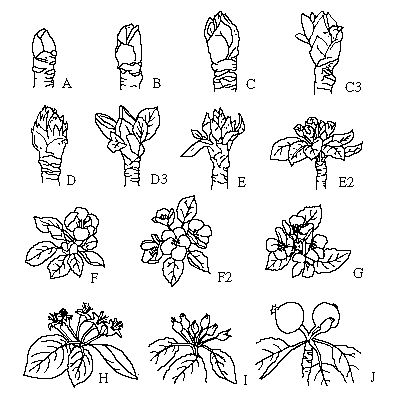
In this short video, Demetrious introduces the basics of fruit trees. We learn how to identify vegetative growth vs fruiting buds, how to distinguish each year's growth, and where the fruit grows.


Wednesday, November 14, 2001

Dormancy - What's really going on

Thanksgiving has passed, the leaves have dropped, the trees are bare, and the Orchard is entering "Dormancy." 
AND... beneath the bark all sorts of things are going on, and the trees are (with chemical reactions) "counting" the days to Spring! Photo-receptors near the leaf scars are noting the ratio between dark hours and light hours (the "photo-period") that's how the tree will know exactly when Spring arrives. All the Enzyme systems that drive the leaf and flower making machinery are on "idle".  As the temperature rises the chemical "gears" will start to whir. The Hormone that signaled the leaves to drop, is now the "brake", keeping everything dormant. When the temperature is cold, the dormancy Hormone will degrade (get used up). When the right number of hours of "chill" have been accumulated (those are the "Chill Hours" on your tree label.  Check it out!,) the brake comes off. With the dormancy hormone is gone, the temperature and photo-period will be in control, so watch the Orchard for the "March Magic." (check the bottom of the email * for more detail)
The trees have been storing up water and sugars that will fuel that first big push of flowers and leaves. (Then that sap begins to flow in Spring, think "Maple Syrup.") 
 
Though looking very quiet and serene, the trees keep working and we've got some Orchard Activities that will have a major effect on how the trees function in the coming year, and how bountiful a harvest you'll enjoy.  By doing these activities you'll also understand a lot more about your Orchard.  Have fun!